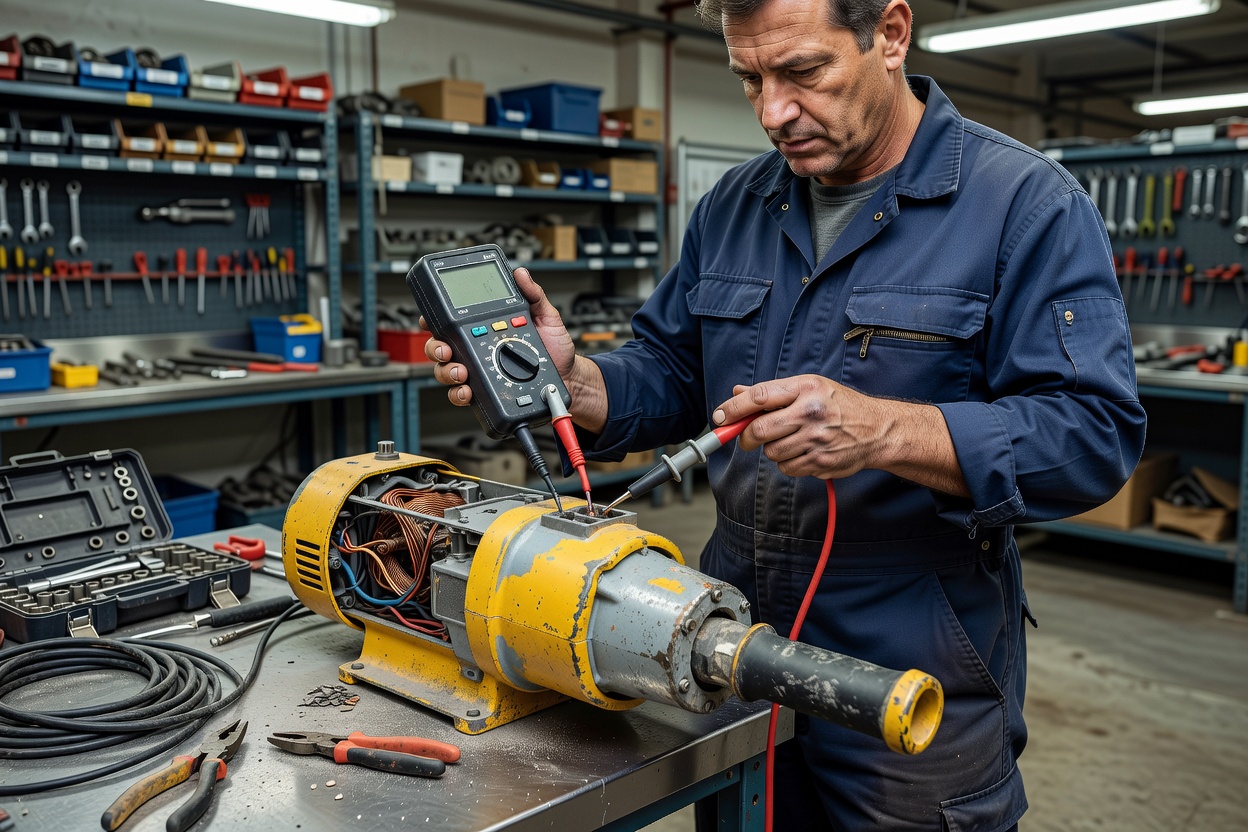
1. PRE-RENTAL VISUAL & PHYSICAL CHECKS
Before any machine moves to the dispatch staging lane, a depot maintenance operator completes a documented visual and functional inspection:
- Cables, Strain Relief & Plugs: Inspect heavy-duty rubber HO7RN-F cables for nicks, crushed jackets, or exposed inner cores. Inspect industrial yellow 110V or blue 230V plugs for heat discoloration or loose pins.
- Guards, Flanges & Shrouds: Ensure diamond cut-off saws have fully operational spring-back guards. Confirm dust extraction ports are unblocked and rubber seals are supple.
- Switches & Interlocks: Verify that dead-man switches, lock-off triggers, and paddle switches disengage power instantly when released. A sticking switch results in immediate red-tagging.
2. ELECTRICAL SAFETY TESTING (PORTABLE APPLIANCE TESTING)
All electric equipment undergoes automated instrument verification:
- Class I Equipment (Earthed): Earth continuity test ensuring earth bond resistance does not exceed 0.1 Ω + cable resistance. Insulation resistance tested at 500V DC (> 1.0 MΩ).
- Class II Equipment (Double Insulated): Insulation resistance tested between live/neutral conductors and outer metal chuck surfaces (> 2.0 MΩ).
- Tagging: Machines passing tests receive a barcode calibration label specifying date, tester ID, and next inspection due date.
SAFETY-CRITICAL SERVICING NOTICE:
Technical repairs, motor brush replacements, electrical rewiring, and internal gearbox servicing must strictly be executed by qualified service personnel in certified depot facilities. End-users and hirers must never open tool housings on jobsites.
3. MECHANICAL WEAR THRESHOLDS & TOLERANCES
Rotary hammers, core drills, and floor grinders experience heavy abrasive stress. Technicians monitor key wear tolerances:
- SDS-Max & Hex Chuck Play: Chuck bushings are checked with calibrated gauge pins. Excessive radial play (> 1.5 mm) causes bit wobble, excessive chisel binding, and fractured hammer pistons.
- Spindle Runout: Diamond coring motor spindles are checked with a dial indicator. Spindle runout exceeding 0.05 mm causes premature diamond segment stripping and core barrel binding.
- Engine Governors & Oil Alert: Petrol compactors and generators are tested under tachometers to confirm idle and governor-regulated operating RPM (typically 3,600 RPM). Low-oil shutoff sensors are tested prior to release.
4. POST-HIRE RETURN INSPECTION & CLEANING RULES
When a tool returns from a jobsite, it enters the Wash & Triage Bay. Hirers are expected to remove surface concrete slurry, damp mortar crust, and heavy dust before return:
- External Decontamination: Tools returning with cured solid concrete encrusting the cooling vents require chemical softening and manual scraping. Excessive slurry ingress into motor windings incurs a standard depot cleaning charge.
- Accessory Inventory: Bits, drift keys, auxiliary guide handles, and carry cases are inventoried against the outbound manifest.
- Damage Documentation: Any cracked housing, bent depth gauge, or cut cable is logged with photographic records on the return slip, and the unit is quarantined for workshop bench repair.
| Component | Inspection Standard | Quarantine Threshold | Maintenance Action |
|---|---|---|---|
| Power Lead Cable | Continuous jacket, no cuts | Any exposed copper / taped repair | Full replacement of cable assembly |
| SDS-Max Tool Chuck | Internal ball retainers lubricated | Radial play > 1.5 mm / sticking collar | Chuck nose assembly overhaul |
| Anti-Vibration Mounts | Rubber dampers intact without tears | Cracked rubber / excess handle play | Complete replacement of damper bushings |
| Diamond Core Spindle | Dial runout ≤ 0.05 mm | Runout > 0.05 mm / thread galled | Spindle shaft refacing or replacement |
| Compactor Base Plate | Uniform thickness, no deep gouges | Base wear < 3 mm remaining | Plate replacement before fleet return |
GOOD FOR
- Zero-downtime reliability on active commercial sites
- Verified operator electrical safety in wet site conditions
- Consistent vibration compliance within stated decibels/exposure
- Clear audit trails for health and safety compliance inspectors
WHAT TO CHECK FIRST
- PAT inspection tag date is current on tool body
- Ventilation cooling slots are free of dried slurry
- Chisel shank fits smoothly into chuck without hammering
- Auxiliary side handles clamp securely without slipping